TL;DR: Water damage restoration typically costs $1,500 to $15,000 for most residential jobs, with the average falling between $3,000 and $7,500. The biggest cost drivers are the water category (clean vs. gray vs. sewage), how many square feet are affected, and how long the water sat before extraction started. Basement floods and sewage backups land at the higher end. A burst supply line caught within hours lands at the lower end. Every job is different, and a written scope from a certified firm protects you before any work begins.
If you’re reading this at 11 p.m. with wet carpet and a call to your insurance company already scheduled for tomorrow morning, you need real numbers fast. DISS Restoration is available 24/7 at (724) 981-1441 and serves Youngstown, Warren, Boardman, and the surrounding area. The ranges below reflect what homeowners in the region actually pay in 2026.
How Much Does Water Damage Restoration Cost?
Water damage restoration costs $1,500 to $15,000 for most homes, with the national midpoint around $3,500 to $5,000. Jobs involving sewage, finished basements, or water that sat for more than 48 hours routinely exceed $10,000 once mold prevention and structural drying are factored in.
The single number you see on aggregator sites is almost useless for planning. Cost depends on four variables that vary wildly from job to job: the category of water involved, the total square footage affected, the materials that got wet (drywall vs. hardwood vs. concrete), and how quickly mitigation started. The table below breaks it down by scenario.
| Damage Scenario | Typical Cost Range |
|---|---|
| Clean water, single room, caught within 24 hrs | $1,200 - $3,500 |
| Clean water, 500-1,000 sq ft, minor materials | $3,000 - $6,000 |
| Gray water (appliance overflow, toilet), single room | $2,500 - $5,500 |
| Flooded basement, clean water, unfinished | $2,000 - $5,000 |
| Flooded basement, finished, 800-1,200 sq ft | $5,000 - $12,000 |
| Sewage backup, any area | $4,500 - $15,000+ |
| Water sat 48+ hrs, mold growth present | $6,000 - $20,000+ |
These are industry-typical ranges. Your actual cost depends on the specific conditions of your loss. DISS Restoration provides a written scope before any work begins.
What Water Category Is Your Damage, and Why Does It Matter?
The IICRC S500 standard, the industry’s governing document for water damage response, classifies water into three categories that directly drive labor, PPE requirements, and disposal costs.
Category 1 (Clean water) comes from a supply line, a broken appliance hose, or rainfall through a roof. It poses no immediate health risk. Extraction and structural drying are the primary tasks. Cost per square foot for Category 1 mitigation typically runs $3 to $8.
Category 2 (Gray water) comes from dishwashers, washing machines, toilet bowl overflows (no feces), or sump pump failures. It contains contaminants that can cause illness. Affected porous materials like drywall and carpet pad often need removal rather than drying. Cost per square foot rises to $6 to $12 because of the added disposal and sanitization steps.
Category 3 (Black water) includes sewage backups, floodwater from outside, and any water that has been standing long enough to grow bacteria. This is the most expensive category because all porous materials it touched must be removed and disposed of properly, and the crew needs full PPE. Cost per square foot for Category 3 jobs runs $10 to $20 or more, and the total bill for a finished basement can exceed $15,000 before reconstruction.
Water category can also degrade over time. Clean water that sits for 48 hours in warm conditions becomes gray water. Gray water left longer becomes black water. Every hour of delay costs money.
What Does Water Damage Restoration Cost Per Square Foot?
Water damage restoration costs $3 to $20 per square foot for the mitigation phase alone, depending on water category and materials affected. Reconstruction (replacing drywall, flooring, cabinets) is billed separately and can equal or exceed the mitigation cost.
Here is how to estimate your exposure before a contractor arrives:
- Measure the affected area. Include all rooms where flooring, walls, or ceilings show moisture, not just the room where the water entered.
- Identify the water category. Use the definitions above. When in doubt, assume Category 2.
- Multiply. A 400 sq ft finished basement with Category 2 water: 400 x $9 (midpoint) = $3,600 for mitigation. Add $2,000 to $5,000 for drywall and flooring replacement and you’re looking at $5,600 to $8,600 total.
- Add a contingency for hidden moisture. Moisture meters and thermal imaging often reveal wet wall cavities and subfloor saturation that aren’t visible. Budget 15-20% above your initial estimate.
For a detailed breakdown specific to basement flooding, see our post on flooded basement cleanup costs, timelines, and when to call a pro.
What Drives the Cost Up (or Down)?
Several factors move the final number significantly in either direction.
Response time is the biggest lever you control. Mitigation started within 4 hours of a loss typically costs 30-50% less than the same job started 48 hours later, because secondary damage (swollen framing, delaminated subfloor, mold colonization) hasn’t had time to compound. The IICRC S500 standard recommends beginning drying within 24-48 hours to prevent mold growth.
Materials affected matter because not all wet materials are equal. Concrete block basement walls dry in place. Fiberglass insulation must be removed and replaced. Hardwood floors may be salvageable with aggressive drying or may require full replacement. Cabinets with particleboard cores almost always need to go. A restoration firm with IICRC ASD (Applied Structural Drying) certification knows how to make these calls correctly, which saves you money on unnecessary tear-out and protects you from inadequate drying that leads to mold.
Mold presence adds cost in two ways: remediation itself (typically $1,500 to $6,000 for a contained area) and the additional containment and air scrubbing required during the water mitigation work. If your water damage is more than two days old, factor mold remediation into your budget. See our post on signs of hidden mold to know what to look for.
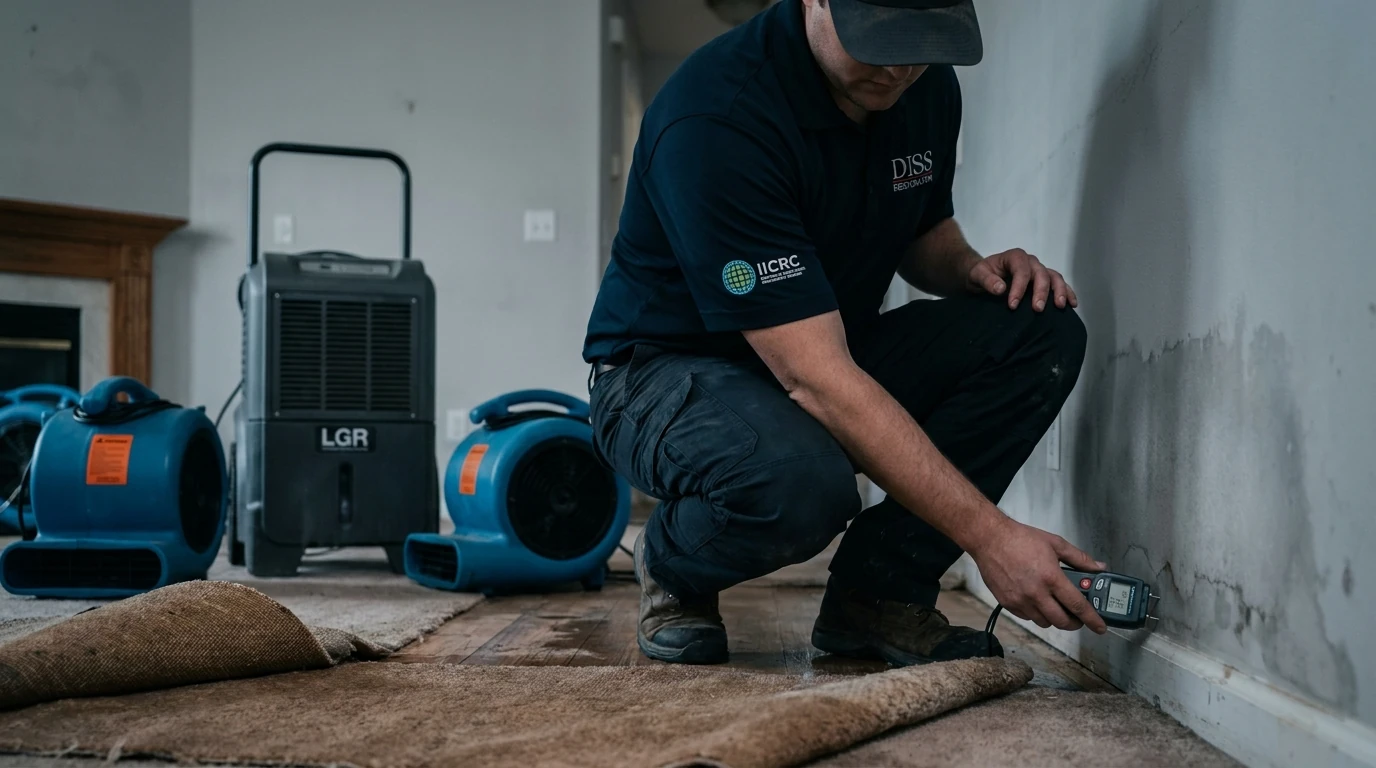
Structural drying equipment runs continuously for 3 to 5 days on average. Industrial LGR (Low Grain Refrigerant) dehumidifiers and high-velocity air movers are placed per IICRC drying calculations, not guesswork. Firms that use consumer-grade box fans and rental dehumidifiers often leave moisture in wall cavities that triggers mold within weeks.
Geographic labor rates affect the final number. Costs in the Youngstown and Mahoning Valley area are generally below the national midpoint, which is reflected in the ranges above.
Will Homeowners Insurance Cover Water Damage Restoration?
Most standard homeowners policies cover sudden, accidental water damage but exclude gradual leaks and flooding from outside the home. A burst pipe is typically covered. A slow leak under the sink that went unnoticed for six months is typically not.
For a detailed breakdown of what policies cover and how to document your claim, see our post on whether homeowners insurance covers water damage.
A few practical points that affect your restoration cost under an insurance claim:
- Your deductible comes first. If your deductible is $2,500 and the job is $3,800, you’re paying $2,500 out of pocket and the insurer covers $1,300. For smaller jobs, it may not be worth filing.
- Documentation protects your claim. Moisture readings, photos of affected materials, and a written scope of work from a certified firm give your adjuster what they need to approve the full scope. Verbal estimates from uncertified contractors create disputes.
- Mitigation and reconstruction are often two separate claims processes. The mitigation (extraction, drying, demolition of unsalvageable materials) is usually approved quickly. Reconstruction (new drywall, flooring, paint) may require a separate supplement.
DISS Restoration works directly with insurance carriers and provides the documentation adjusters need, including moisture logs, equipment placement records, and IICRC-standard drying reports.
What Happens When You Call a Restoration Company?
Knowing the process helps you evaluate whether the firm you’re hiring is doing it right.
- Emergency response and assessment. A certified technician arrives, identifies the water source (if still active), and uses moisture meters and thermal imaging to map the full extent of moisture intrusion.
- Water extraction. Truck-mounted or portable extractors remove standing water. This is the fastest phase.
- Demolition of unsalvageable materials. Wet drywall below the flood line, saturated insulation, and compromised flooring are removed to expose the structure for drying.
- Structural drying. LGR dehumidifiers and air movers are placed per IICRC drying calculations. Readings are taken daily and logged. The average residential dry-out takes 3 to 5 days.
- Antimicrobial treatment. Affected framing and concrete are treated to inhibit mold growth during and after drying.
- Final moisture verification. A technician confirms all readings are within acceptable limits before equipment is removed. This documentation is what protects you if mold appears later.
- Reconstruction. Once the structure passes final moisture verification, rebuild begins. This phase is billed separately from mitigation.
If a contractor skips step 6 or can’t provide moisture logs, that is a red flag. Proper documentation is not optional under the IICRC S500 standard.
For a written estimate on your specific loss, call DISS Restoration at (724) 981-1441). Their IICRC-certified team is available 24/7 and serves Youngstown, Warren, Boardman, Austintown, Niles, Girard, and surrounding communities. A written scope is provided before any work begins.
About DISS Restoration
DISS Restoration is an IICRC Certified Firm serving Youngstown, OH and the greater Mahoning Valley since 2021, licensed and insured in Pennsylvania and Ohio. Their certified technicians hold IICRC credentials in Water Damage Restoration (WRT), Applied Structural Drying (ASD), Mold Remediation (AMRT), and Fire and Smoke Restoration (FSRT). The company also holds EPA Lead-Safe certification and OSHA training. Services include water damage restoration, mold remediation, fire damage restoration, storm damage restoration, sewage cleanup, biohazard cleanup, contents restoration, asbestos abatement, and emergency board-up and tarping. Available 24/7 at (724) 981-1441.