24/7 Emergency Sewage Cleanup and Sanitization in Farrell
24/7 emergency sewage cleanup and sanitization in Farrell and surrounding areas. IICRC-certified, insurance billing accepted. Call (724) 981-1441.
Sewage backup in your home or business? Raw sewage is classified as Category 3 black water, meaning every minute it sits on flooring, baseboards, or drywall increases the risk of contamination spreading into subfloor and framing. We answer 24/7 and treat every sewage call as a biohazard event from the first phone call, not a standard water loss.
What Sewage Cleanup and Sanitization actually involves
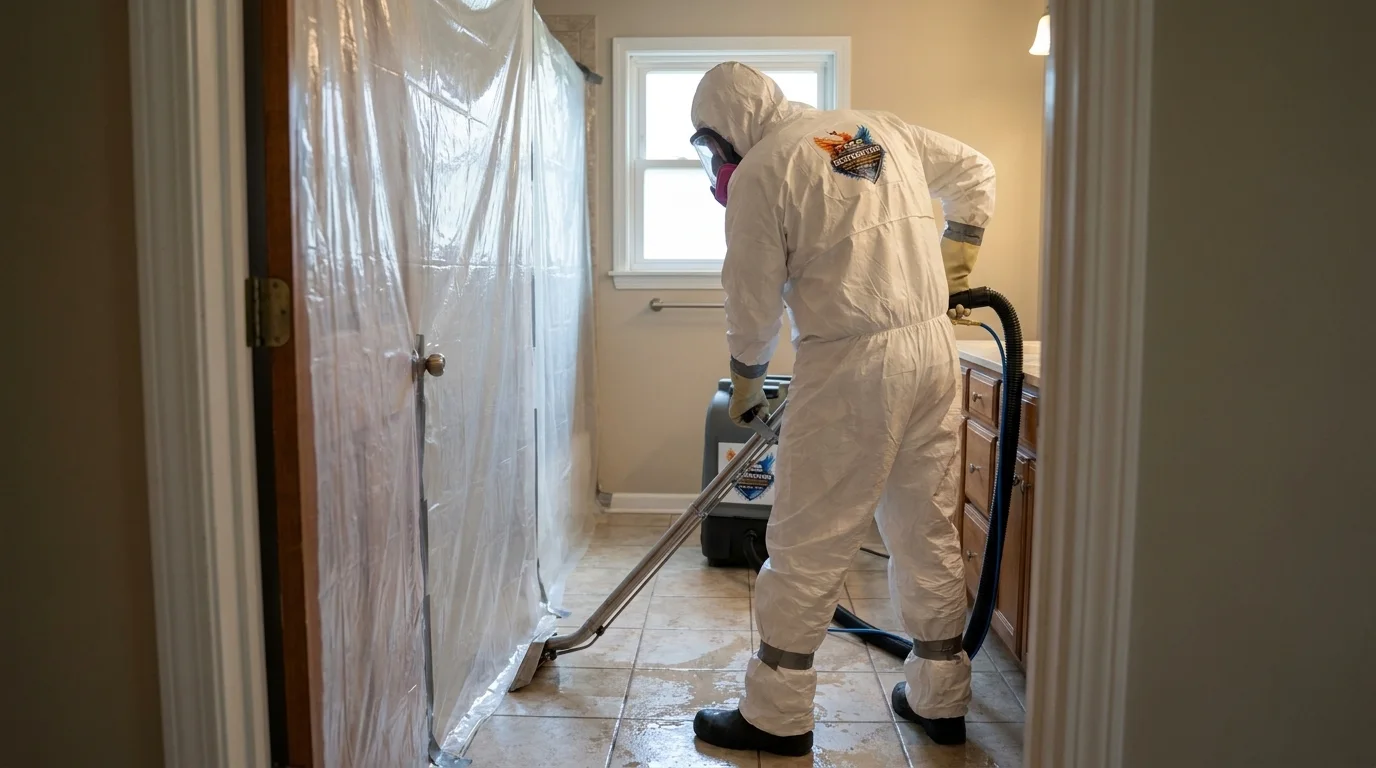
A sewage backup is never just a water problem. Whether it’s a sewer line backup pushing waste up through a floor drain, a septic overflow saturating a crawlspace, or a toilet line failure that’s been running for hours before anyone noticed, the water carries bacteria, viruses, and parasites that make standard extraction and drying unsafe on their own. Crews work in full PPE (gloves, respirators, boot covers, and in bad cases, full suits) and treat the loss as contaminated from the start. Porous materials that absorbed sewage, carpet pad, drywall below the flood line, baseboards, often can’t be saved and have to come out rather than be dried in place. Equipment includes truck-mount extraction, antimicrobial and enzymatic treatments, and air scrubbers to manage odor and airborne particulate while the space dries. Depending on how long the backup sat and how far it traveled under flooring, a job can run from a single day for a contained bathroom event to over a week when subfloor and wall cavities are involved.
Our process
- Contamination assessment. We identify the source (sewer line, septic, plumbing fixture) and trace how far the black water traveled, including under cabinets, behind baseboards, and into wall cavities.
- Raw sewage removal. Standing waste and contaminated water are extracted first, using pumps and truck-mount equipment rated for black water, before any drying equipment goes in.
- Removal of unsalvageable materials. Carpet, pad, and affected drywall or insulation that contacted sewage are cut out and bagged for disposal, since sanitizing porous materials that have absorbed Category 3 water isn’t reliable.
- Cleaning and sanitization. Remaining hard surfaces, framing, and subfloor are cleaned with EPA-registered antimicrobial products and treated to address bacteria and odor at the source, not just mask it.
- Drying and verification. Structural drying equipment runs per IICRC S500 guidelines, with moisture readings taken until the space reaches a dry standard before any reconstruction starts.
What separates a good sewage cleanup response from a bad one
The most common mistake is trying to dry sewage-contaminated materials instead of removing them. Drying equipment can bring a wet drywall panel back to a normal moisture reading, but it doesn’t remove the bacteria that soaked in, and insurance adjusters know to ask whether contaminated porous materials were actually removed or just dried and painted over. A thorough response also documents the extent of contamination with photos and moisture mapping before demolition starts, since that documentation is what supports the claim later. Another gap is odor: if sanitization only addresses visible surfaces and skips the subfloor or wall cavity where waste traveled, the smell comes back within days as residual bacteria continues breaking down organic material. Good operators also test for cross-contamination into adjacent rooms via HVAC returns or flooring seams, something that’s easy to miss on a quick walkthrough.
What does Sewage Cleanup and Sanitization cost?
Costs vary widely depending on how much contaminated material has to be removed, how far the water traveled, and whether flooring or framing is affected. Below are typical industry ranges; every loss is different, and DISS Restoration provides a written scope of work before any cleanup begins so you know what’s included. Homeowners insurance often covers sudden sewage backups (such as a sewer line failure) under standard dwelling coverage, though gradual seepage or lack of a sewer backup endorsement can affect what’s paid; we document the loss and handle the claim paperwork either way.
| Scenario | Typical range |
|---|---|
| Single bathroom, contained overflow | $500 - $1,500 |
| Basement sewage backup, moderate spread | $3,000 - $7,000 |
| Whole-room sewage event with flooring and drywall removal | $7,000 - $15,000 |
| Septic overflow affecting crawlspace or yard | $5,000 - $12,000 |
| Large structure, Category 3 water with structural demo | $10,000+ |
Seasonal & regional considerations
Older homes throughout Farrell and the surrounding Shenango Valley were largely built in the early-to-mid 1900s, when cast iron and clay sewer lines were standard, both of which are prone to root intrusion and joint failure as they age. Heavy spring rain and snowmelt can also push municipal sewer systems closer to capacity, which raises the risk of backups in homes on lower-lying lots or near older combined sewer lines. Septic systems in more rural parts of Mercer County are similarly stressed during wet seasons when the ground is already saturated and has less capacity to absorb overflow.
Service area
DISS Restoration handles sewage cleanup and sanitization in Farrell and throughout the surrounding Shenango Valley, including nearby communities in Mercer County, Pennsylvania.
If raw sewage has backed up into your home or business, stop using water in the affected plumbing and call (724) 981-1441 to start sewage cleanup and sanitization before contamination spreads further into the structure.
Services We Handle
- Basement Sewage Cleanup
- Category 3 Water Cleanup
- Cleaning & Sanitizing
- Sewage Backup Cleanup
- Sewage Backups
- Sewage Cleanup & Remediation
- Sewage Damage
- Water Damage Sewage Cleanup
Frequently Asked Questions
Does homeowners insurance cover sewage cleanup and sanitization?
Why can't sewage-soaked carpet or drywall just be cleaned and dried?
What's the difference between cleaning up a sewer line backup and a septic overflow?
What should I do while waiting for a sewage cleanup crew to arrive?
How do you know when sanitization is actually finished and the space is safe?
Looking for the best sewage cleanup and sanitization company in Farrell?
DISS Restoration provides sewage cleanup and sanitization in Farrell, PA and the surrounding area, and has served local property owners since 2021. Customers rate us 4.6 out of 5 stars across 87 Google reviews. We answer calls 24/7 — call (724) 981-1441 for immediate help.
Need Sewage Cleanup and Sanitization now?
We respond 24/7 across Farrell and surrounding PA cities.
Related Coverage
- Our Restoration Services
- Contact DISS Restoration
- 24/7 Emergency Sewage Cleanup and Sanitization in Austintown
- 24/7 Emergency Sewage Cleanup and Sanitization in Boardman
- 24/7 Emergency Sewage Cleanup and Sanitization in Campbell
- 24/7 Emergency Sewage Cleanup and Sanitization in Canfield
- 24/7 Emergency Sewage Cleanup and Sanitization in Girard
- 24/7 Emergency Sewage Cleanup and Sanitization in Hubbard
- 24/7 Emergency Sewage Cleanup and Sanitization in Mineral Ridge
- 24/7 Emergency Sewage Cleanup and Sanitization in New Castle
- 24/7 Emergency Sewage Cleanup and Sanitization in Niles
- 24/7 Emergency Sewage Cleanup and Sanitization in Struthers
- 24/7 Emergency Sewage Cleanup and Sanitization in Warren
- 24/7 Emergency Sewage Cleanup and Sanitization in Youngstown