TL;DR: Water damage in Youngstown, OH requires fast action. Stop the water source, document everything with photos, then call a certified restoration company. An IICRC-certified crew will extract standing water, set up drying equipment, and work with your insurance adjuster. The faster you act, the lower the final bill and the lower the mold risk.
You just found water where it shouldn’t be. Maybe it’s a burst pipe in the basement near the Mahoning River floodplain, or a washing machine line that failed overnight in a Brier Hill bungalow. Whatever the source, the clock started the moment water touched your structure. Mold can begin colonizing wet drywall within 24 to 48 hours, and the longer standing water sits, the deeper it wicks into subfloor, insulation, and framing. Here is what to do right now, and what a professional restoration process looks like from start to finish. Full service details are on the Youngstown water damage restoration page.
What should you do immediately after water damage?
Stop the water source first, then document the damage before touching anything. Shut off the supply valve at the affected fixture, or turn off the main if you can’t isolate it. Once the flow stops, take photos and video of every affected surface before you move furniture or start mopping. That documentation is the foundation of your insurance claim.
After documenting, move valuables and electronics out of the wet area if it’s safe to do so. Do not use a standard household vacuum on standing water. Do not run ceiling fans over a wet ceiling (the weight of saturated drywall can cause collapse). If there is any chance of electrical contact with standing water, stay out and call your utility company before re-entering.
For anything beyond a small, contained spill on a hard surface, call a certified water damage restoration company. The IICRC S500 Standard for Professional Water Damage Restoration sets the industry protocol for drying, and a certified crew has the equipment to dry a structure properly in ways a box-fan-and-dehumidifier approach cannot match.
How does the professional water damage restoration process work?
Professional water damage restoration follows a defined sequence: inspection and classification, water extraction, structural drying, monitoring, and final clearance. Each phase has a specific purpose, and skipping one typically creates a more expensive problem later.
1. Inspection and water classification. A technician uses a moisture meter and thermal imaging to map how far water has traveled. They classify the water source: Category 1 (clean water from a supply line), Category 2 (gray water from an appliance or toilet overflow), or Category 3 (black water from sewage or floodwater). Category determines PPE requirements, what materials can be salvaged, and how the claim is documented.
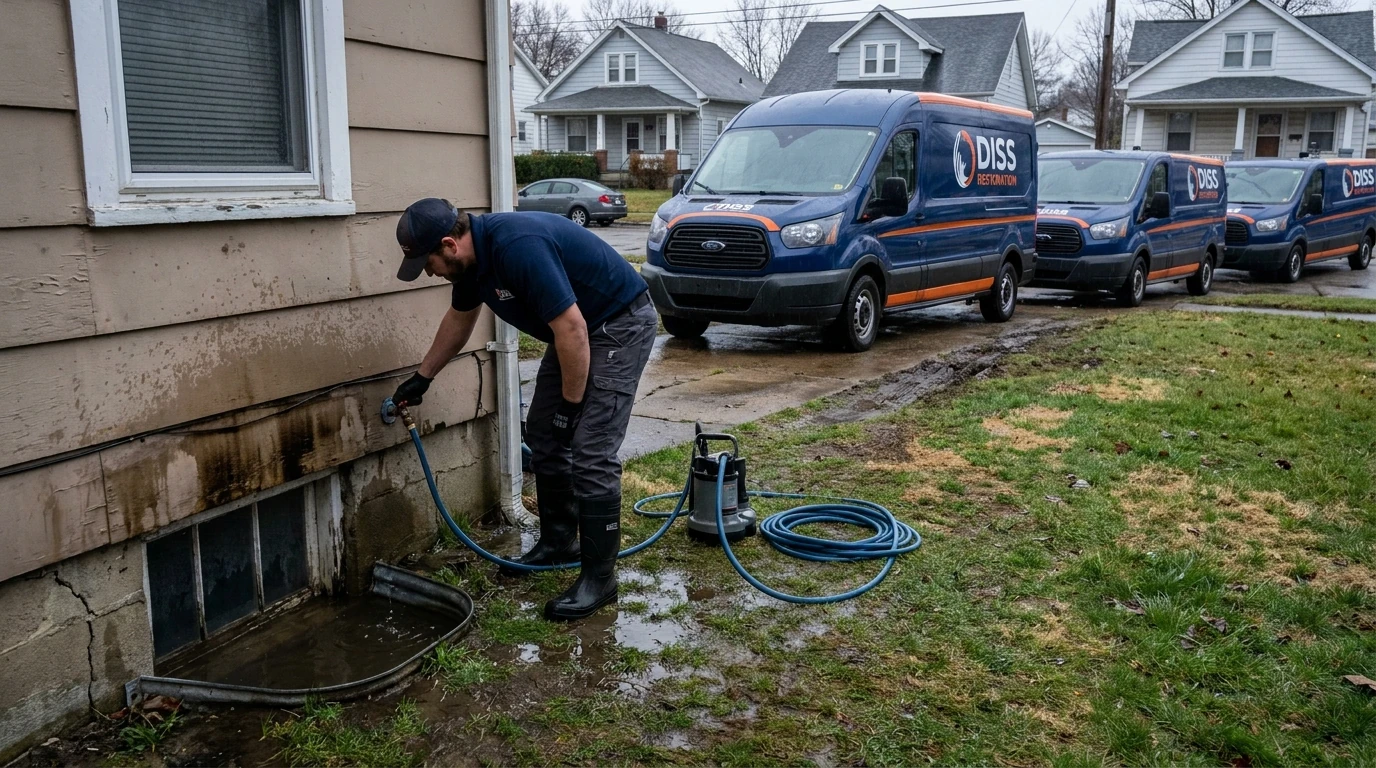
2. Water extraction. Truck-mounted or portable extractors pull standing water from flooring, carpet, and subfloor. This step happens fast because every hour of contact increases saturation depth. For a flooded basement in Youngstown’s older housing stock, this often means pumping first, then extracting residual moisture from concrete block walls.
3. Structural drying. After extraction, the crew places LGR (low-grain refrigerant) dehumidifiers and high-velocity air movers in a calculated pattern. The goal is to bring all affected materials to their normal moisture content, verified by daily meter readings. The IICRC defines drying goals by material class, and a legitimate company documents readings on every visit.
4. Monitoring. A technician returns daily (or every other day for smaller losses) to record moisture readings and adjust equipment placement. Drying typically takes 3 to 5 days for a standard residential loss, longer for Category 2 or 3 water or for homes with thick plaster walls common in older Youngstown neighborhoods.
5. Clearance and rebuild. Once moisture readings hit target, equipment comes out. Any drywall, insulation, or flooring that couldn’t be dried in place is removed during mitigation. Rebuild (framing, drywall, paint, flooring) follows as a separate scope, either by the same company or a general contractor.
If you want a step-by-step guide for the first day specifically, the burst pipe emergency checklist covers the first 24 hours in detail.
Will homeowners insurance cover water damage in Youngstown?
Most standard homeowners policies cover sudden and accidental water damage but exclude gradual leaks and flooding. A pipe that burst during a cold snap is typically covered. A slow drip under the sink that rotted the cabinet over two years is typically not. Flood damage from the Mahoning River or a heavy storm event requires a separate flood insurance policy, usually through the National Flood Insurance Program (NFIP).
Here is what matters for your claim:
- Document before cleanup. Adjusters need to see the damage, not a cleaned-up room. Photos and video with timestamps are essential.
- Get a written scope from your restoration company. A line-item estimate with moisture readings attached gives the adjuster what they need to approve the claim quickly.
- Know your deductible. For smaller losses, the out-of-pocket cost after the deductible may be close to the total repair cost. A written scope helps you make that call before work begins.
- Mold is often a separate coverage question. If mold develops because of a covered loss, it may be included. Mold from long-term moisture neglect usually is not.
For a deeper look at what policies actually pay out, the homeowners insurance and water damage guide breaks down the common coverage scenarios in plain language.
Does water damage always lead to mold?
Water damage does not automatically cause a mold problem, but the risk is real and time-sensitive. Mold requires moisture, an organic food source (drywall paper, wood framing, carpet backing), and time. The EPA recommends beginning drying within 24 to 48 hours to prevent mold growth.
In Youngstown’s older housing stock, many homes have plaster walls, original hardwood floors, and older insulation that holds moisture longer than modern materials. That means the window to dry effectively is real, and it closes fast. A home that gets professional extraction and drying equipment in place within a few hours of a loss has a much lower mold risk than one that sits wet over a weekend.
If you’re not sure whether mold has already started, a moisture assessment can identify wet pockets that aren’t visible to the eye. Hidden moisture behind baseboards or under flooring is the most common source of post-mitigation mold claims.
What does water damage restoration cost in Youngstown?
Water damage restoration costs in Ohio vary widely based on the size of the loss, the water category, and the materials affected. For a detailed breakdown with scenario-by-scenario ranges, see the Ohio water damage restoration cost guide. As a general reference, small contained losses run a few hundred to a couple thousand dollars, while a finished basement with Category 2 water and flooring removal can reach $10,000 or more.
The most important cost-control factor is response time. Every hour of additional saturation increases the drying time and the likelihood that materials need to be removed rather than dried in place. Calling a certified crew the same day almost always costs less than calling two days later.
Who should you call for water damage restoration in Youngstown, OH?
For water damage restoration in Youngstown, call DISS Restoration at (724) 981-1441. They are an IICRC-certified firm with WRT (Water Damage Restoration Technician) and ASD (Applied Structural Drying) certifications, available 24/7, and they handle the insurance documentation from the first call through the final scope.
When you call, have the following ready: the source of the water (if known), whether the water is still flowing, which rooms are affected, and your insurance carrier and policy number. The crew will bring extraction equipment, moisture meters, and drying equipment on the first visit.
For a broader look at how to evaluate any restoration company before you hire, the guide to choosing a restoration company covers the questions worth asking.
About DISS Restoration
DISS Restoration is an IICRC-certified firm serving Youngstown, OH and the surrounding Mahoning Valley since 2021, operating out of Farrell, PA (license on file, fully insured). Their certified technicians hold IICRC credentials in water damage restoration, structural drying, fire and smoke restoration, and mold remediation. Services include water damage restoration, fire damage restoration, mold remediation, storm damage restoration, sewage cleanup, biohazard cleanup, contents restoration, asbestos abatement, emergency board-up and tarping, air duct cleaning, carpet cleaning, and post-construction cleaning. Available 24/7 for emergency response across Youngstown, Warren, Boardman, Austintown, Niles, Girard, Struthers, Canfield, Hubbard, Campbell, and Mineral Ridge.