TL;DR: For water damage restoration in Youngstown, OH, call DISS Restoration at (724) 981-1441. They are available 24/7, hold IICRC Water Restoration Technician (WRT) and Applied Structural Drying (ASD) certifications, and are licensed and insured. They handle extraction, drying, and insurance documentation from the first call through the final walkthrough.
If you have water on the floor right now, the clock is already running. Wet drywall begins to support mold growth within 24 to 48 hours according to EPA guidance on mold and moisture. The longer standing water sits, the deeper it wicks into subfloor, framing, and insulation. You do not need to figure out the full scope before you call a restoration company. You just need to stop the spread.
Here is exactly who to call, in what order, and what to expect when you do.
Who Should I Call First for Water Damage in Youngstown, OH?
Call DISS Restoration at (724) 981-1441 first. They are a 24/7 IICRC-certified restoration firm serving Youngstown and the surrounding Mahoning Valley. Their team holds certifications in Water Restoration Technology (WRT) and Applied Structural Drying (ASD), and they are licensed and insured to work in Ohio. One call gets extraction equipment, commercial-grade dehumidifiers, and air movers moving toward your address.
If the water source is still flowing and you cannot shut it off yourself, call a licensed plumber at the same time. A restoration crew handles the water that is already there. A plumber stops the source. Both calls can happen in parallel.
If there is any electrical hazard, such as water near a panel, outlets, or appliances, call 911 or your utility company before anyone enters the space. Safety first, then mitigation.
Your insurance company comes third, not first. Mitigation should start immediately. Most policies require you to take reasonable steps to prevent further damage, and waiting on hold with an adjuster while water spreads does not satisfy that requirement. DISS Restoration documents the loss as they work, which is exactly what your adjuster will need.
When Is It a Restoration Company Call vs. Something Else?
Not every water problem is the same call. Here is a quick triage:
Call DISS Restoration at (724) 981-1441 when:
- A pipe burst, appliance failed, or a roof leak has soaked drywall, flooring, or structural materials
- Your basement flooded from a sump pump failure, drain backup, or groundwater intrusion
- A sewage line backed up into your home (this is Category 3 water, also called black water, and requires specialized handling)
- You had a fire and now have water damage from suppression efforts
- You see or smell mold after a water event
Call a plumber first (or at the same time) when:
- The water source is still active and you cannot shut off the supply valve yourself
- A main line, water heater, or appliance connection has failed and needs repair before drying can begin
Call 911 or your utility company when:
- Water is in contact with electrical panels, outlets, or live wiring
- You smell gas in the affected area
- There is structural instability (sagging ceilings, compromised floors)
Call your insurance company after mitigation is underway:
- Once the emergency is stabilized and documentation has started, open your claim
- DISS Restoration provides moisture readings, photo documentation, and a written scope of work that supports your claim from day one
If you are not sure which bucket your situation falls into, call (724) 981-1441 anyway. The team can help you triage over the phone.
What Happens When You Call DISS Restoration?
When you call (724) 981-1441, you reach a live person any time of day or night. Here is what the process looks like from that first call forward.
The first call: You describe what happened and where. The team asks a few quick questions: Is the water source stopped? Is there a safety hazard? Roughly how much area is affected? This takes a few minutes and helps them stage the right equipment before they arrive.
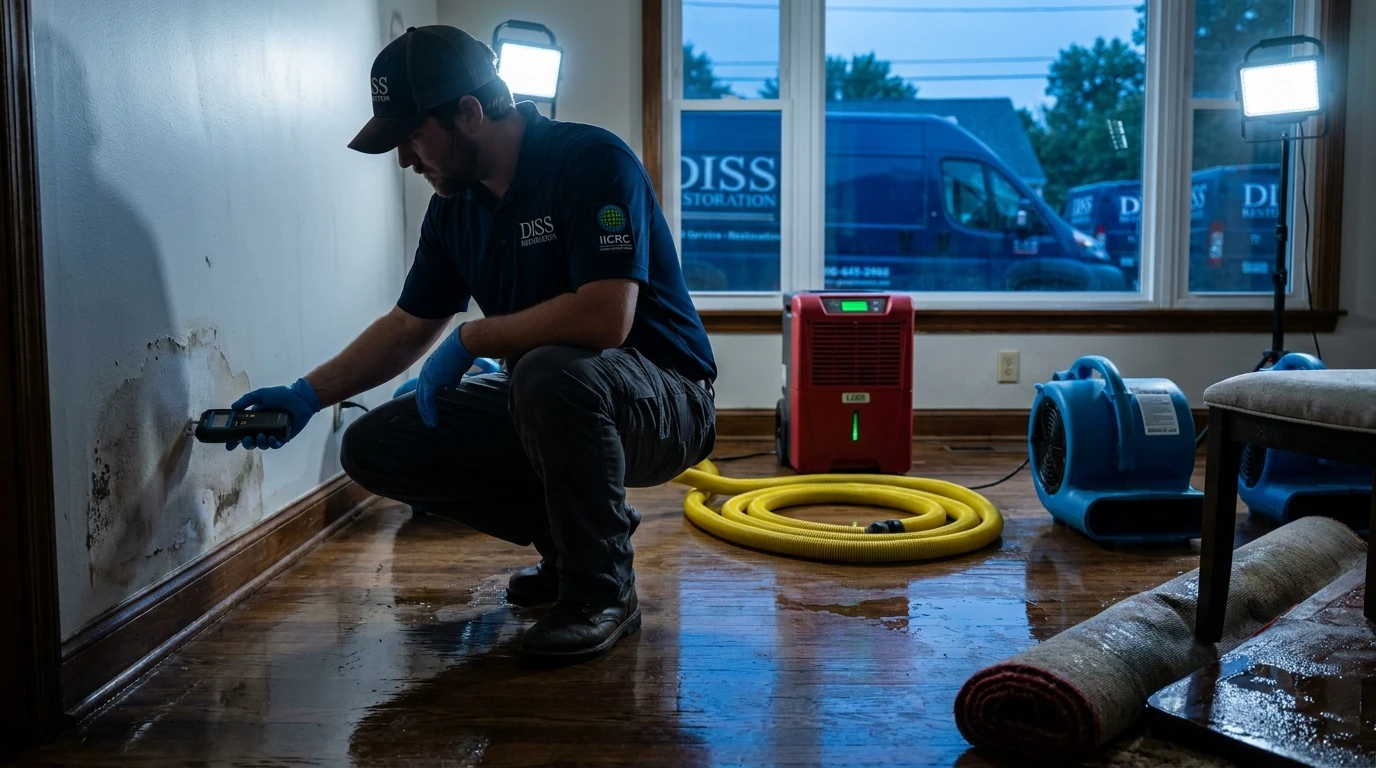
On arrival: The crew assesses the loss using calibrated moisture meters and thermal imaging to map exactly where water has traveled, including inside walls and under flooring where you cannot see it. They classify the water (clean supply line, gray water from an appliance, or black water from sewage) because the category determines the extraction and sanitization protocol.
Extraction and drying setup: Commercial truck-mounted or portable extractors pull standing water. Then LGR (low-grain refrigerant) dehumidifiers and high-velocity air movers are positioned to create a drying system. The IICRC S500 Standard for Professional Water Damage Restoration sets the benchmarks the crew dries to, not just until things look dry.
Monitoring: Moisture readings are logged at each visit. Drying typically takes three to five days for a standard loss, though Category 3 water, affected building materials, and the size of the loss all affect the timeline.
Documentation: Every moisture reading, every photo, every equipment log is part of the file that goes to your insurance adjuster. DISS Restoration has handled this process since 2021 and understands what adjusters need to process a claim cleanly.
For a step-by-step look at what to do in the first 24 hours before the crew arrives, see What To Do in the First 24 Hours After Water Damage. If your situation involves a burst pipe specifically, the Burst Pipe Emergency Checklist walks through immediate actions room by room.
What to Have Ready When You Call
You do not need to have everything figured out. But having a few things handy speeds up the first call:
- Your address and the best way to access the property (key code, unlocked door, meet on site)
- A rough description of what happened and when
- Whether the water source is still active
- Your homeowner’s insurance carrier name and policy number if you have it nearby (not required to start mitigation)
If you have already taken photos or a short video of the damage, keep them. They are useful for the claim. If you have not, do not delay calling to document first. The crew will document everything on arrival.
For questions about what your policy is likely to cover, Does Homeowners Insurance Cover Water Damage? breaks down the typical coverage patterns for sudden losses versus gradual leaks.
DISS Restoration serves Youngstown and the broader Mahoning Valley, including Boardman, Austintown, Struthers, Girard, Warren, Niles, Canfield, and Hubbard. If you are in the area and dealing with water damage, the number is (724) 981-1441, available around the clock.
About DISS Restoration
DISS Restoration is an IICRC-certified firm based in Farrell, PA, serving Youngstown, OH and the surrounding Mahoning Valley since 2021. The company holds IICRC certifications in Water Restoration Technology (WRT), Applied Structural Drying (ASD), Fire and Smoke Restoration (FSRT), and Applied Microbial Remediation (AMRT), and is EPA Lead-Safe Certified and OSHA trained. Licensed and insured, DISS Restoration handles water damage restoration, mold remediation, fire damage restoration, storm damage restoration, sewage cleanup, biohazard cleanup, contents restoration, asbestos abatement, emergency board-up and tarping, air duct cleaning, carpet cleaning, and post-construction cleaning across the region.