24/7 Emergency Water Damage Restoration in Lowellville
24/7 emergency water damage restoration in Lowellville, OH. IICRC-certified, insurance billing accepted. Call (724) 981-1441.
Our IICRC-certified technicians are dispatched from our Farrell, PA headquarters and are typically on-site in Lowellville within 60 minutes of your call.
Water damage in Lowellville rarely waits for convenient timing. Between the Mahoning River running along the village’s edge and a housing stock built largely in the early-to-mid 1900s during the Mahoning Valley’s steel era, water finds its way into basements and crawlspaces here in ways that newer suburban construction doesn’t experience. Whether it’s a failed sump pump during spring runoff or a supply line that gave out in a century-old kitchen, DISS Restoration answers 24/7 and brings IICRC-trained technicians who know how older Mahoning County homes hold and release water differently than modern builds.
Why Lowellville Properties See Water Damage Issues
Lowellville’s location along the Mahoning River means a meaningful share of the village sits close to the floodplain, and heavy regional storms can push groundwater up through foundation walls and floor slabs that were never engineered with a vapor barrier. Add in a lot of housing built before mid-century, when cast iron and galvanized steel supply lines were standard, and you get a second common source of loss: corroded pipe failures inside walls and under slabs that go unnoticed until a ceiling stain or a spike in the water bill gives it away. Winters in this part of Ohio also bring hard freeze-thaw cycles, which stress older plumbing runs in unheated crawlspaces and attached garages, a frequent cause of burst-pipe calls we see across the Mahoning Valley.
Our Water Damage Restoration Process in Lowellville
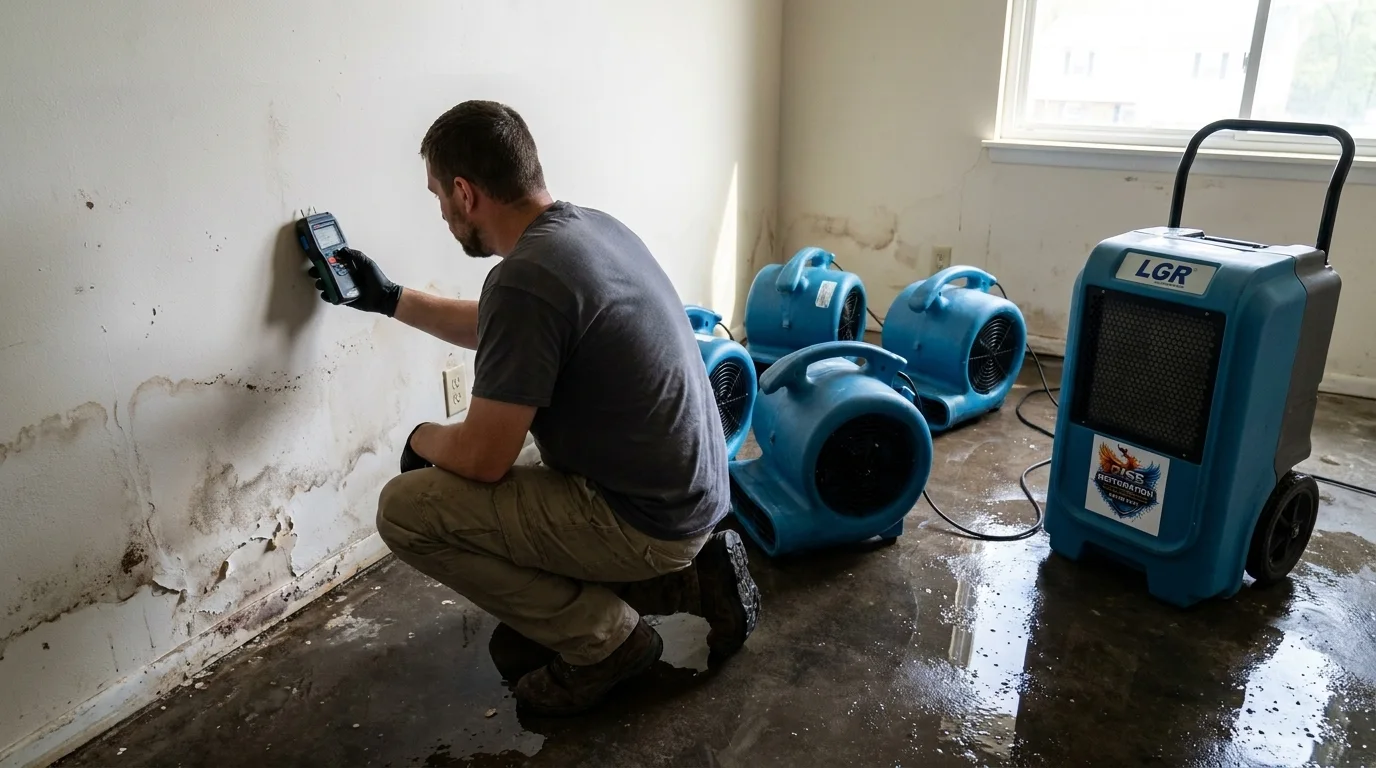
The first step on any call is stopping the source and assessing how far water has traveled, which in Lowellville’s older homes often means checking behind plaster and lath walls, not just drywall. Plaster absorbs moisture more slowly than drywall but holds onto it longer, so we adjust drying timelines accordingly rather than pulling equipment too early because surface readings look dry. Extraction comes next, using truck-mounted or portable pumps depending on how much standing water has pooled in a basement or crawlspace, followed by moisture mapping to find out whether water has migrated into subfloor framing, which is common in houses with the kind of fieldstone or parged-block foundations typical of this area. Structural drying is set up and monitored daily, with psychrometric readings logged so the file matches IICRC S500 drying standards insurance adjusters expect to see.
Reaching Lowellville from Youngstown
DISS Restoration is based in Youngstown, a short run down Route 7 into Lowellville, which keeps us close enough to respond quickly when a pipe lets go overnight or a storm backs up a floor drain. Because the village is compact, we’re usually familiar with the general layout of a street before we arrive, whether that’s a riverside property with a walkout basement or an older two-story closer to the village center with a shared alley for equipment staging. We call ahead to confirm driveway or alley access, especially on narrower streets near the river where parking a drying trailer takes some planning.
Insurance Coordination for Lowellville Homeowners
Most water losses in Lowellville get filed through homeowners insurance, and because many of these houses are older, adjusters often ask for more documentation on pre-existing wear versus new damage, particularly around foundation walls and plumbing. We photograph and log moisture readings room by room as we go, which gives the carrier a clear timeline distinguishing storm or pipe-failure damage from any prior settling or wear typical of a home this age. That documentation tends to move claims along faster and reduces back-and-forth between the homeowner and the adjuster.
Local note
A lot of the older homes near the river in Lowellville were built with fieldstone or rubble foundations rather than poured concrete, and those foundations wick groundwater differently than a modern slab. Extraction in a stone-foundation basement often needs to continue longer at a lower intensity, since the stone itself holds moisture and can re-wet a drying room if pulled too soon. We factor that into equipment placement and drying time rather than following a one-size timeline.
If water is spreading through your Lowellville home right now, don’t wait on it to dry on its own, especially in a basement with stone or block walls where moisture can sit unseen for days. Call DISS Restoration at (724) 981-1441 for water damage restoration built around how this village’s homes and ground actually behave.
Serving Lowellville from our Farrell headquarters — ★ 4.6 · 87 Google reviews
“Very easy to work with. Peasant and polite employees.” — Susan, October 2026Read our reviews on Google →
Water Damage Restoration in Lowellville: Service Coverage
Frequently Asked Questions
How fast can you arrive for water damage restoration in Lowellville?
How fast can DISS Restoration reach a home in Lowellville from your Youngstown base?
Do Lowellville's older stone-foundation basements need a different drying approach?
Will water damage from the Mahoning River floodplain be treated differently than an indoor pipe burst?
How does plaster construction in Lowellville's older homes affect water damage restoration timelines?
Can you help document water damage claims for insurance in Lowellville?
Water Damage Restoration response in Lowellville
Most Lowellville calls see a technician on-site within 60 minutes from our Farrell headquarters.