
Mold Inspection and Testing in Farrell
24/7 mold inspection and testing in Farrell and surrounding areas. IICRC-certified, insurance billing accepted. Call (724) 981-1441.
A musty smell that won’t go away after a leak dried out. A water stain on the ceiling that never got checked. A new allergy flare-up every time the HVAC kicks on. These are the moments homeowners in Farrell call for mold inspection and testing rather than mold remediation, because the first question isn’t “how do we remove it,” it’s “do we actually have a mold problem, and how big is it.” A proper inspection answers that with data instead of guesswork, before anyone starts tearing into drywall.
What mold inspection and testing actually involves
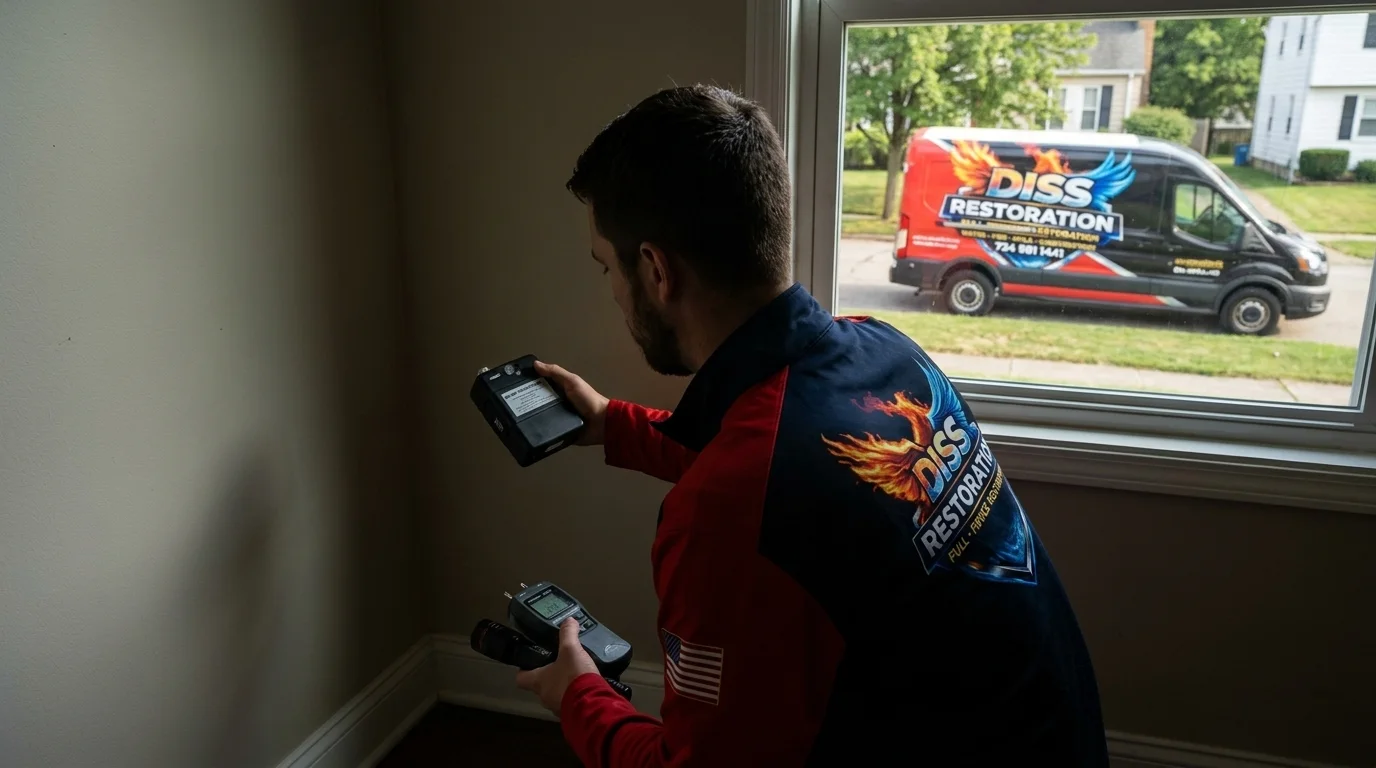
Mold inspection and testing is a diagnostic process, not a cleanup process. A technician walks the property with a moisture meter and a thermal imaging camera, looking for the conditions mold needs to grow: trapped humidity, past or active water intrusion, poor ventilation in bathrooms and crawlspaces, condensation on cold surfaces. Visible growth gets documented and sampled. Areas with no visible growth but suspicious moisture readings or odor get air sampled to check for elevated spore counts compared to outdoor baseline air. Depending on the property, this can mean swab samples of a stained patch of drywall, tape lifts off a surface, or air pumps running for several minutes in each zone to capture spores onto a cassette. Samples go to a third-party accredited lab, not back-of-truck guesswork, and results typically return within a few business days. The inspection itself usually takes one to three hours depending on square footage and the number of suspect areas.
Our process
- Intake and history: we ask about past leaks, flooding, recent renovations, HVAC issues, and where the odor or symptoms are strongest, because mold almost always traces back to a moisture event.
- Visual and moisture survey: a room-by-room walkthrough with a moisture meter and thermal camera to flag elevated readings behind walls, under flooring, and around plumbing penetrations.
- Sampling: air samples in suspect zones plus an outdoor control sample, and surface samples (swab or tape lift) on any visible growth, labeled and chain-of-custody documented.
- Lab analysis: samples go to an independent laboratory for spore identification and spore count comparison against the outdoor baseline.
- Written report: findings, lab results, and a scope of recommended next steps, which becomes the baseline document for remediation decisions or insurance discussions.
What separates a good mold inspection from a bad one
A common mistake is skipping the outdoor control sample. Without it, an indoor spore count is meaningless; you need a baseline to know whether indoor levels are actually elevated or just reflect what’s blowing around outside that day. Another is sampling only where mold is visible and ignoring moisture readings elsewhere, which misses hidden growth behind baseboards or under subfloor that hasn’t surfaced yet. Inspectors working under IICRC AMRT guidelines also document moisture source, not just mold presence, because a report that says “mold found” without identifying the water source that fed it isn’t actionable. Insurance adjusters reviewing a claim want to see the moisture meter readings, photos of the affected materials, and lab chain-of-custody paperwork, not just a verbal opinion. A report built that way holds up whether it’s used for a remediation scope or a claims conversation.
What does mold inspection and testing cost?
Costs vary by property size, number of sample points, and whether both air and surface samples are needed. Every property is different, and DISS Restoration provides a written scope with exact sampling counts before any testing begins. Homeowners insurance typically does not cover routine mold inspection unless it’s tied to a covered water loss, in which case the inspection may be included as part of the claim documentation.
| Scenario | Typical range |
|---|---|
| Single room, visual inspection only | $150 - $300 |
| Standard home inspection, 2-3 air samples | $300 - $650 |
| Whole-house inspection with air and surface sampling | $600 - $1,200 |
| Crawlspace or attic-focused inspection | $250 - $500 |
| Post-remediation clearance testing | $300 - $600 |
Seasonal & regional considerations
Farrell’s humid summers and older housing stock with basements and crawlspaces create a long window each year where indoor humidity can sit high enough for mold to establish, especially in homes without dehumidification. Winter brings a different risk: homes sealed tight against the cold trap moisture from cooking, showers, and drying laundry, and condensation on cold basement walls or rim joists can feed growth that isn’t noticed until spring. Spring thaw and heavy rain periods are also when past water damage that was never fully dried tends to reveal itself as a musty smell or discoloration, which is often when inspection calls spike.
Service area
DISS Restoration provides mold inspection and testing throughout Farrell and the surrounding Shenango Valley communities. Older housing stock, basements, and crawlspace foundations common across this region are exactly the conditions where hidden moisture and mold tend to go unnoticed without proper testing equipment.
If something smells off, looks off, or you’re not sure whether a past leak left a lasting problem, request an air quality test and get a lab-backed answer before deciding what to do next. Call DISS Restoration at (724) 981-1441.
Services We Handle
- Mold Inspection
- Mold Testing
- Water Damage Mold Inspection
Frequently Asked Questions
Does homeowners insurance cover mold inspection and testing?
What's the difference between air sampling and surface sampling?
How long does it take to get mold testing lab results back?
Do I need a mold inspection if I already see visible mold?
Can I stay in my home during a mold inspection?
Looking for the best mold inspection and testing company in Farrell?
DISS Restoration provides mold inspection and testing in Farrell, PA and the surrounding area, and has served local property owners since 2021. Customers rate us 4.6 out of 5 stars across 89 Google reviews. We answer calls 24/7 — call (724) 981-1441 for immediate help.
Need Mold Inspection and Testing now?
We respond 24/7 across Farrell and surrounding PA cities.