
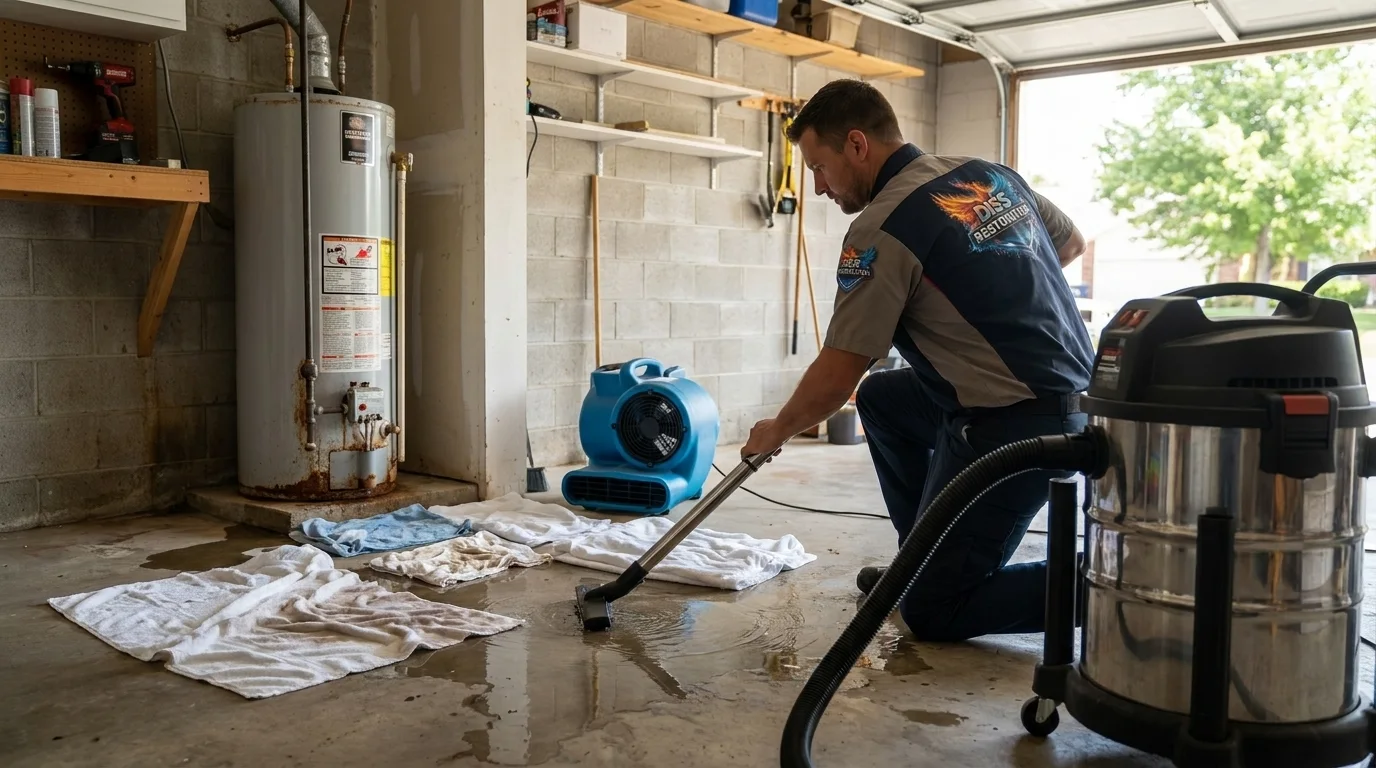
24/7 Emergency Water Heater Flood Cleanup in Farrell
24/7 emergency water heater flood cleanup in Farrell and surrounding areas. IICRC-certified, insurance billing accepted. Call (724) 981-1441.
Water heater leaking or burst in your Farrell home? Call (724) 981-1441 now. We answer 24/7 and can start water heater flood cleanup before the standing water migrates into subflooring, drywall, and the HVAC system below.
A failed water heater rarely announces itself gently. Most homeowners discover it as a puddle creeping out from a utility closet, a soaked carpet in the room above a basement unit, or a ceiling stain that shows up a day after the tank actually split. By the time it’s visible, water has usually already tracked under baseboards, into wall cavities, and down through floor joists, which is why a mop and a shop-vac rarely solve it on their own.
What Water Heater Flood Cleanup Actually Involves
A burst or slow-leaking water heater behaves differently depending on where the tank sits. A unit in a basement or crawlspace often empties 30 to 50 gallons directly onto a concrete slab, where it spreads fast and wicks into anything porous it touches: subfloor, insulation, stored boxes, framing. A unit in an upstairs closet or garage can send water down through ceiling cavities and light fixtures before anyone notices, which turns a single-point leak into a multi-room job. Cleanup starts with shutting off the water supply and power to the tank, then extracting standing water with truck-mounted or portable pumps. From there it’s moisture mapping with thermal imaging and penetrating meters to find where the water actually went, not just where it’s visible, followed by structural drying with air movers and dehumidifiers set up per IICRC S500 guidelines. Depending on the tank’s age and mineral buildup, the water released can also carry sediment and rust, which changes what surfaces need cleaning versus just drying.
Our Process
- Source control and safety check. We confirm the water and gas or electric supply to the tank is off before anyone steps into standing water, and check for any electrical hazard where water has reached outlets or panels.
- Extraction. Pumps and extraction wands remove bulk water from floors, carpet, and pad before it has more time to wick into subfloor and framing.
- Moisture mapping. Thermal imaging and moisture meters trace water migration into walls, cabinetry toe-kicks, and the subfloor beneath flooring that still looks dry on top.
- Controlled drying. Air movers and dehumidifiers are placed based on the moisture map, not guesswork, with daily monitoring until materials read dry.
- Cleaning and odor control. Any sediment, rust staining, or mineral residue from the tank gets cleaned from affected surfaces, and we flag anything showing early mold growth for a separate remediation scope.
What Separates a Good Water Heater Flood Cleanup Response From a Bad One
The most common mistake is drying the surface and stopping. Carpet and visible drywall can read dry within a day while the subfloor or the wall cavity behind a baseboard is still saturated. A thorough response checks under flooring and inside walls with a moisture meter before equipment comes down, not just when the carpet feels dry to the touch. Another common gap is ignoring where the water actually traveled. Water heaters are often tucked in closets or corners, and the leak can travel along a slab seam or follow a joist bay well outside the room where the tank sits, soaking an adjacent closet or the room below. Adjusters reviewing these claims generally want documented moisture readings at the start and at clearance, photos of the source and the extent of travel, and a clear explanation of why equipment was placed where it was. Skipping that documentation is one of the more common reasons a claim gets questioned later.
What Does Water Heater Flood Cleanup Cost?
Costs vary with how much water escaped, how far it traveled before discovery, and what materials got wet. A tank caught within an hour in a basement with a floor drain costs far less to remediate than one that leaked overnight under a kitchen. Every loss gets a written scope before any work begins, since every situation is different. Homeowners insurance typically covers sudden water heater failures under the dwelling’s water damage provisions, though gradual leaks from long-term neglect may be excluded, so it’s worth checking your policy language.
| Scenario | Typical range |
|---|---|
| Caught early, small area, concrete floor | $500 - $1,500 |
| Single room, carpet and pad affected | $1,200 - $3,000 |
| Multi-room spread, subfloor saturation | $3,000 - $7,000 |
| Water traveled through ceiling below | $4,000 - $9,000 |
| Extended undetected leak with mold growth risk | $6,000 - $15,000+ |
Seasonal & Regional Considerations
In Farrell and the surrounding Shenango Valley, older housing stock often still runs original or aging water heaters, and winter cold snaps put extra strain on tanks that are already near the end of their service life. A tank that’s been quietly rusting through a seam can let go during a freeze when demand on the unit spikes, and basements here are commonly unfinished or semi-finished, which means standing water spreads across a slab quickly before anyone upstairs notices.
Service Area
We respond to water heater flood cleanup calls throughout Farrell and nearby communities including Sharon, Hermitage, Sharpsville, and Wheatland, along with the surrounding Mercer County area.
If a water heater has already failed or is actively leaking, don’t wait for it to “dry on its own.” Call (724) 981-1441 to schedule your water heater flood cleanup and get a written drying scope started before hidden moisture turns into a bigger repair.
Frequently Asked Questions
Does homeowners insurance cover water heater flood cleanup?
How do I know if water from a leaking water heater reached my subfloor?
Is the water from a burst water heater considered clean water?
How long does drying take after a water heater floods a room?
Can mold start growing after a water heater leak before I notice it?
Looking for the best water heater flood cleanup company in Farrell?
DISS Restoration provides water heater flood cleanup in Farrell, PA and the surrounding area, and has served local property owners since 2021. Customers rate us 4.6 out of 5 stars across 89 Google reviews. We answer calls 24/7 — call (724) 981-1441 for immediate help.
Need Water Heater Flood Cleanup now?
We respond 24/7 across Farrell and surrounding PA cities.