Mold Remediation in Lowellville
24/7 mold remediation in Lowellville, OH. IICRC-certified, insurance billing accepted. Call (724) 981-1441.
Our IICRC-certified technicians are dispatched from our Farrell, PA headquarters and are typically on-site in Lowellville within 60 minutes of your call.
Mold problem in Lowellville? The Mahoning River runs close enough to much of the village that basements and crawlspaces here stay damp longer than homeowners expect, and that extra humidity is exactly what mold needs to take hold behind drywall, under flooring, and along sill plates. DISS Restoration handles mold remediation for Lowellville homes and small commercial buildings, and we answer 24/7 since mold doesn’t wait for business hours to spread.
Why Lowellville Properties See Mold Issues
Lowellville sits in the Mahoning River valley in Mahoning County, and that river proximity shapes a lot of what we see on remediation calls here. Groundwater sits higher than in the surrounding hill towns, which means basements that look dry on a sunny day can still be wicking moisture through foundation walls year-round. Add in a housing stock that skews older, many homes built during the valley’s steel-era growth with original masonry foundations, and you get a combination of porous block, shallow footings, and decades-old plumbing that was never sealed against the kind of humidity swings Northeast Ohio gets between a wet spring and a humid August. Flat-roofed outbuildings and older additions common in the village also tend to hold condensation in attic spaces, which shows up as ceiling staining long before anyone smells anything.
Our Mold Remediation Process in Lowellville
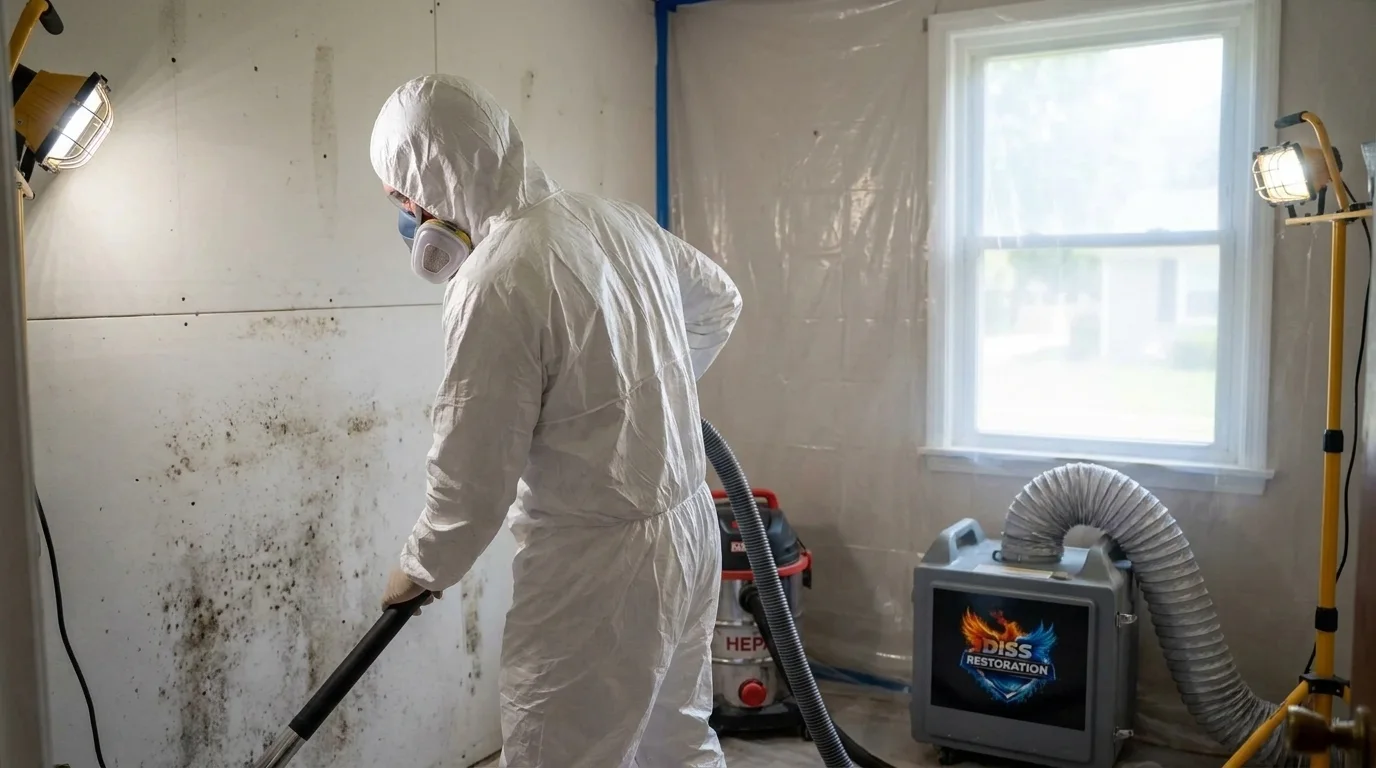
We start with a visual and moisture inspection, checking not just the obvious stain but the framing and subfloor around it, because mold almost never stops at the edge of what’s visible. Once we’ve mapped the extent of growth, we set up containment, usually negative-air chambers with HEPA filtration, so spores don’t travel into the rest of the house while we work. Affected porous materials like drywall, insulation, and carpet padding that can’t be fully cleaned get removed and bagged for disposal; solid framing and subfloor get HEPA-vacuumed and treated with an EPA-registered antimicrobial. For older Lowellville homes with masonry foundations, we pay close attention to the mortar joints themselves, since mold can colonize the porous surface of aged block in a way it won’t on poured concrete. We close out with air scrubbing and, where the scope calls for it, a post-remediation verification check before containment comes down.
Reaching Lowellville from Farrell
Farrell sits just across the state line, which keeps our drive into Lowellville short. That matters for mold calls more than people realize: a slow leak that’s been feeding a wall cavity for two weeks is already a remediation job, but a leak caught early is often just a drying job. Being close enough to respond promptly means we’re more often catching problems in that earlier window, before colonization spreads past a single stud bay or joist.
Local note
One thing we watch for specifically in this part of the valley: homes close to the river or on lower-lying streets often have sump pumps that were added decades after the house was built, tied into foundations that were never designed around active water management. When that pump fails or the discharge line freezes in winter, the water doesn’t just pool, it saturates the surrounding soil against the foundation and pushes moisture through the block for days before anyone notices a musty smell. If your sump pump is older than your roof, it’s worth having both checked before they become a mold call.
Equipment & Methods We Use for Mold
Containment barriers, negative-air machines, and HEPA air scrubbers are standard on every job regardless of scope, because controlling airborne spore movement protects the rest of the structure, not just the room we’re working in. For the antimicrobial and biocide-treated sections, we follow IICRC S520 guidelines for mold remediation, which govern containment levels, PPE, and clearance criteria based on the condition rating of the contaminated area. Our technicians hold IICRC AMRT training specifically for mold work, which shapes how we scope containment levels and determine when a space is ready to be reopened.
If you’re seeing staining, smelling that persistent musty odor, or you’ve had standing water in a Lowellville basement or crawlspace in the last few weeks, don’t wait for it to spread further through the framing. Call DISS Restoration at (724) 981-1441 for mold remediation in Lowellville, and we’ll get a technician out to assess the scope before it grows past what a contained job can handle.
Serving Lowellville from our Farrell headquarters — ★ 4.6 · 87 Google reviews
“Very easy to work with. Peasant and polite employees.” — Susan, October 2026Read our reviews on Google →
Mold Remediation in Lowellville: Service Coverage
Frequently Asked Questions
How fast can you arrive for mold remediation in Lowellville?
How does Lowellville's proximity to the Mahoning River affect mold risk in basements?
Are older Lowellville homes with masonry foundations more prone to mold growth?
What's the typical process for mold remediation in a Lowellville home with an older sump pump?
Do you provide air clearance testing after mold remediation in Lowellville?
Will my homeowner's insurance cover mold remediation in Lowellville?
Mold Remediation response in Lowellville
Most Lowellville calls see a technician on-site within 60 minutes from our Farrell headquarters.