Industrial Restoration in Farrell
24/7 industrial restoration in Farrell and surrounding areas. IICRC-certified, insurance billing accepted. Call (724) 981-1441.
Industrial water damage or fire damage in Farrell? We answer 24/7 and mobilize industrial-grade equipment scaled for warehouses, production floors, and plant square footage, not residential units stretched past their limits.
A burst supply line above a production line, a sprinkler head that triggers during a fire, or a roof drain that backs up over a warehouse floor doesn’t behave like a flooded basement. Industrial losses involve concrete slabs, structural steel, exposed ductwork, electrical panels, and often machinery that corrodes or shorts out within hours of water contact. Delay compounds the damage fast: standing water on a warehouse floor can undermine subfloor coatings, and smoke residue settles into HVAC systems and conveyor housings in ways a shop vacuum and a box fan were never built to handle.
What industrial restoration actually involves
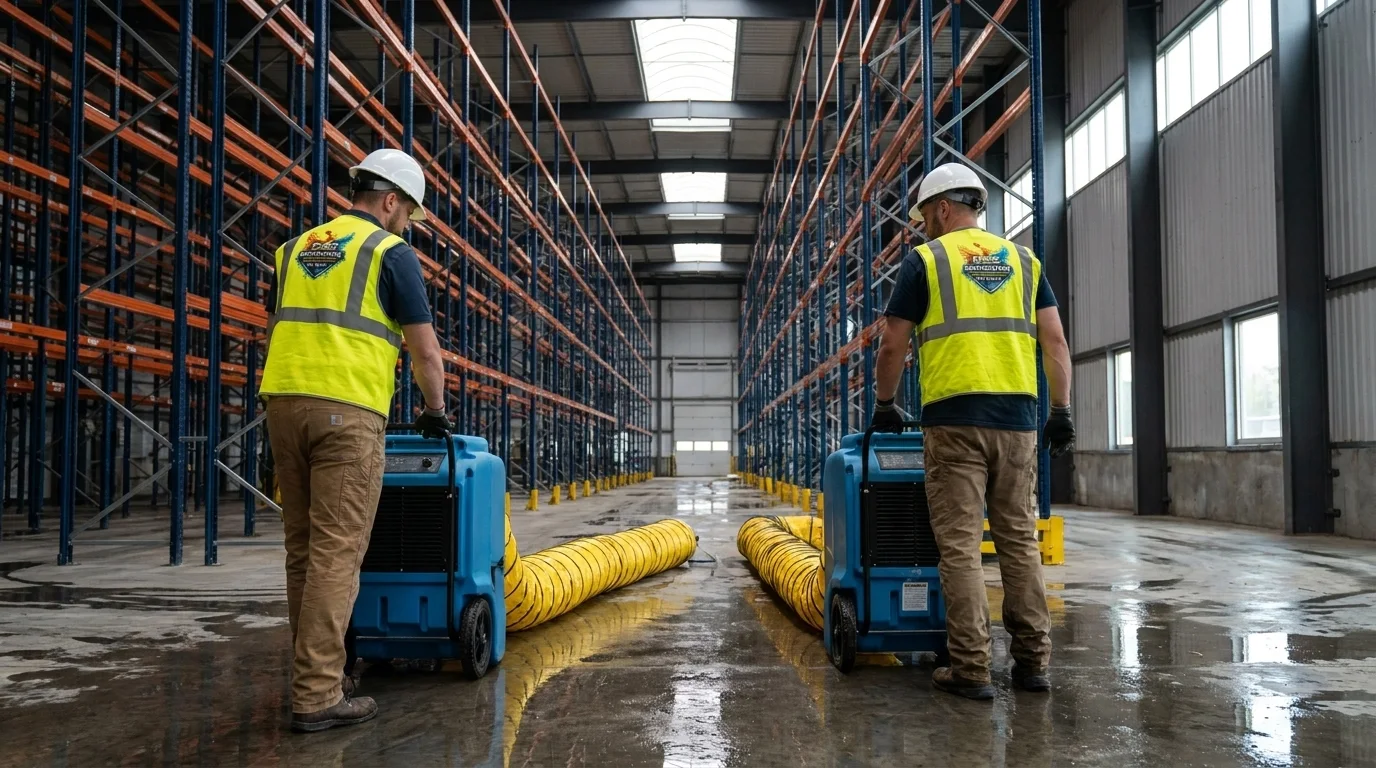
Industrial restoration covers water damage, fire and smoke damage, and large-loss structural drying inside manufacturing facilities, warehouses, distribution centers, and processing plants. The scope is different from a residential job in scale and in the stakes: a flooded production floor isn’t just wet drywall, it’s downtime, spoiled inventory, and machinery that can’t come back online until moisture readings confirm it’s safe. Our crews work with desiccant dehumidification systems sized for open-span buildings, truck-mounted extraction for high-volume water removal, and thermal fogging or HEPA filtration for smoke and soot that has traveled through dust collection or HVAC ductwork. Depending on the facility’s size and the extent of the loss, stabilization can begin within hours, with full drying or smoke remediation running from several days to a few weeks for larger footprints.
Our process
- Facility assessment and hazard identification. Before equipment goes in, we walk the affected area with facility staff to flag electrical panels, chemical storage, and production equipment that need isolation or special handling.
- Large-loss mobilization. Industrial extraction units and desiccant dehumidifiers get deployed by zone, matched to the cubic footage and construction type rather than a one-size approach.
- Phased drying and remediation. Many plants can’t shut down entirely, so we often work zone by zone, drying and clearing one section while another stays operational under containment.
- Equipment and asset protection. Machinery, electrical components, and sensitive inventory get moisture monitoring, corrosion inhibitors, or controlled drying rather than blanket treatment that risks further damage.
- Documentation for claims and business interruption. Moisture logs, photos, and drying reports are compiled to support both the property claim and any business interruption coverage the facility carries.
What separates a good industrial restoration response from a bad one
The most common mistake is treating an industrial space like an oversized house: bringing in residential dehumidifiers that can’t keep up with the air volume, or drying the visible floor while moisture stays trapped under machine bases and in wall cavities behind insulated metal panels. Corrosion on electrical panels and conduit is another thing that gets missed when crews don’t involve a facility’s maintenance or EHS staff early. Adjusters reviewing industrial claims look for documented psychrometric readings across the full affected area, not just a handful of spot checks, and they expect to see a clear record of what equipment ran, where, and for how long. Skipping that documentation is one of the fastest ways a claim gets delayed or underpaid.
What does industrial restoration cost?
Costs vary widely based on square footage, the category of water or extent of fire damage, and whether production equipment is involved. These are typical industry ranges, not a quote: every facility and every loss is different, and DISS Restoration provides a written scope of work before any restoration begins. Most commercial property policies cover sudden water and fire losses, and many facilities carry separate business interruption coverage, but coverage details depend on the specific policy.
| Scenario | Typical range |
|---|---|
| Small warehouse, single-zone water intrusion | $5,000 - $15,000 |
| Mid-size manufacturing facility, multi-zone water damage | $25,000 - $75,000 |
| Industrial equipment decontamination after smoke exposure | $10,000 - $40,000 |
| Plant-wide structural drying with desiccant systems | $15,000 - $60,000 |
| Large warehouse fire and smoke damage restoration | $50,000 - $200,000+ |
Seasonal & regional considerations
The Shenango Valley’s older industrial buildings, many dating from the region’s steel manufacturing era, often have flat or low-slope roofs that pond water and can fail during heavy rain or rapid snowmelt. Unheated warehouse sections are vulnerable to frozen and burst pipes during western Pennsylvania’s winter freeze-thaw cycles, particularly in loading dock areas and along exterior walls. Facilities running dust collection or open-bay doors seasonally should also expect humidity swings that affect how quickly a water loss dries.
Service area
DISS Restoration handles industrial and plant restoration throughout Farrell and the surrounding Shenango Valley, including Sharon, Hermitage, Sharpsville, and Mercer County’s broader industrial corridor.
If water or fire has hit your facility, get a written scope of work started before the damage spreads to machinery, inventory, or structural components. Call (724) 981-1441 to begin an industrial restoration assessment.
Services We Handle
- Industrial Cleaning
Frequently Asked Questions
Does commercial property insurance cover industrial water and fire damage restoration?
How do you dry a large warehouse or plant floor without shutting down the entire facility?
What happens to machinery and electrical equipment exposed to water or smoke?
How is drying an industrial facility different from drying a home?
How long does an industrial restoration project usually take?
Looking for the best industrial restoration company in Farrell?
DISS Restoration provides industrial restoration in Farrell, PA and the surrounding area, and has served local property owners since 2021. Customers rate us 4.6 out of 5 stars across 89 Google reviews. We answer calls 24/7 — call (724) 981-1441 for immediate help.
Need Industrial Restoration now?
We respond 24/7 across Farrell and surrounding PA cities.