Large Loss and Catastrophic Response in Farrell
24/7 large loss and catastrophic response in Farrell and surrounding areas. IICRC-certified, insurance billing accepted. Call (724) 981-1441.
When a loss crosses the threshold from a single-trade repair into a multi-building, multi-million-dollar event, the response has to change shape entirely. A burst main that floods three floors of a mixed-use building, a fire that takes out a manufacturing line, a flash flood that hits an entire commercial corridor: these losses involve multiple insurance carriers, general contractors, engineers, and public adjusters working off the same timeline, often with business interruption costs accruing by the hour. DISS Restoration mobilizes crews and equipment for exactly this scale of event, coordinating directly with large loss adjusters from the first walkthrough.
What large loss and catastrophic response actually involves
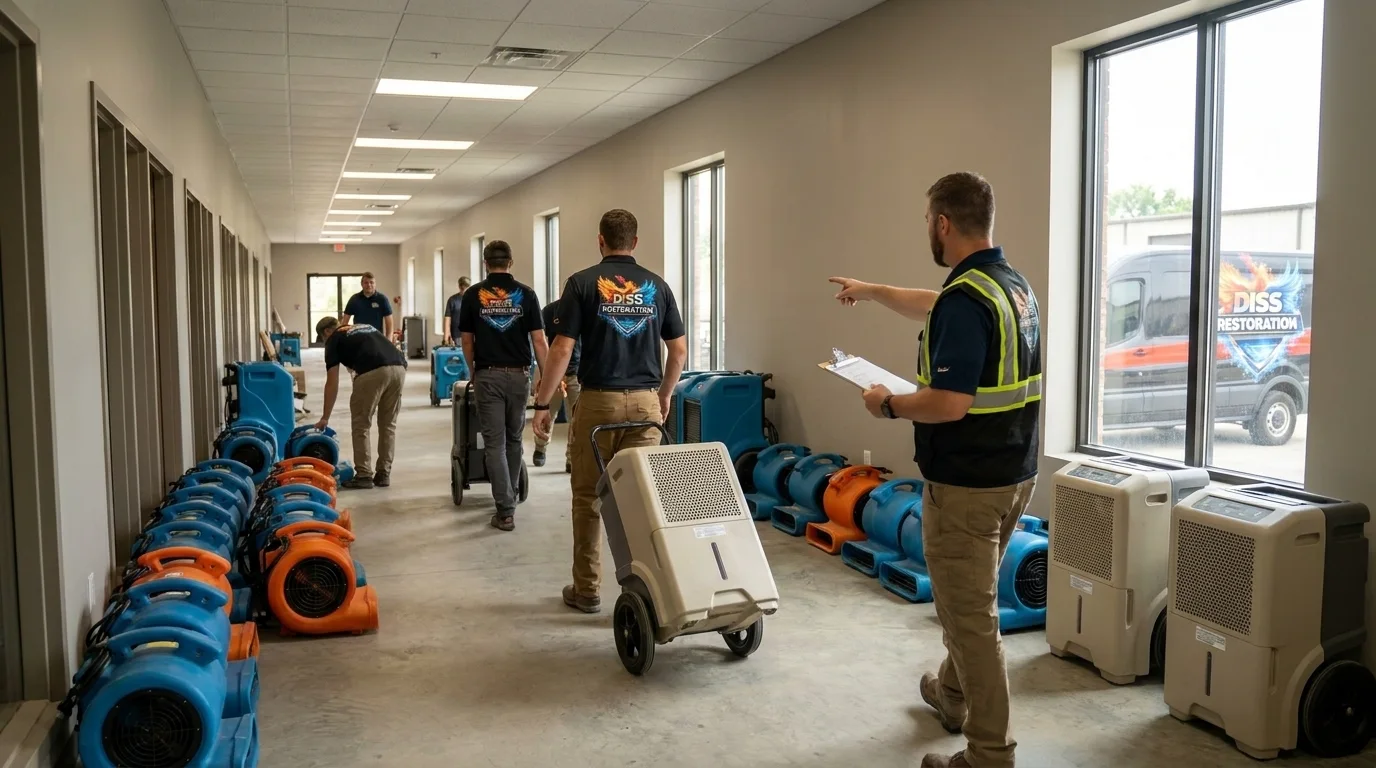
Large loss restoration is defined less by square footage and more by complexity: multiple structures or units affected, more than one insurance carrier or policy involved, specialty equipment requirements (desiccant dehumidification, negative air for large footprints, structural monitoring across floors), and a scope of work that needs engineering review before demolition even starts. A catastrophic event, whether storm, flood, or fire, typically means crews on-site around the clock during the first 48 to 72 hours, with equipment counts in the dozens rather than units, and a project manager dedicated solely to documentation and carrier communication rather than hands-on work. Timelines run from weeks for a contained commercial loss to many months for a full-building rebuild.
Our process
- Rapid mobilization and triage. Crews and equipment deploy to stabilize the site, secure the structure, and stop active water intrusion or fire spread before anything else happens.
- Multi-trade scoping. A detailed scope of work is built across trades (mitigation, structural, mechanical, electrical) and shared with every carrier and adjuster attached to the loss, not just one.
- Phased mitigation and demolition. Work proceeds in sections so unaffected areas stay operational where possible, particularly important for occupied commercial or multi-tenant buildings.
- Continuous moisture and air monitoring. Large footprints require structured monitoring logs across every affected zone, tracked daily and shared with adjusters as the drying or remediation progresses.
- Reconstruction handoff. Once mitigation is complete and cleared, the project transitions into reconstruction with permits, engineering sign-off, and a documented paper trail from day one through final walkthrough.
What separates a good large loss response from a bad one
The most common failure on catastrophic jobs is fragmented documentation. When multiple carriers are involved, every moisture reading, every piece of equipment on-site, and every demolition decision needs a timestamp and a photo, because large loss adjusters will cross-reference the file against the invoice. Crews without a dedicated project manager often lose track of equipment placement across a large footprint, which leads to under-drying in sections that get missed during daily walk-throughs. Another frequent gap is sequencing: starting reconstruction before structural moisture content is verified and cleared, which reopens the claim when materials fail later. A properly run large loss job keeps one point of contact across the entire event, logs equipment and readings by zone, and loops in structural engineers before any load-bearing decisions get made.
What does large loss and catastrophic response cost?
Every large loss event is different, and DISS Restoration provides a written scope of work, built with adjusters and engineers where needed, before mitigation begins. Costs below reflect typical industry ranges for events of this scale and are not a quote; commercial property insurance typically covers the structural mitigation and reconstruction, with business interruption coverage handled as a separate line item depending on the policy.
| Scenario | Typical range |
|---|---|
| Single-building commercial water loss, under 50,000 sq ft | $75,000 - $250,000 |
| Multi-building catastrophic flood or storm loss | $500,000 - $2,000,000+ |
| High-rise or multi-tenant fire loss | $1,000,000 - $5,000,000+ |
| Large-scale mold remediation following a flood event | $150,000 - $600,000 |
| Combined structural restoration and business interruption claim | $2,000,000 - $10,000,000+ |
Seasonal & regional considerations
Western Pennsylvania’s older commercial and industrial building stock, much of it brick and masonry construction from the early-to-mid 1900s, tends to hold moisture inside wall cavities and chases far longer than modern framing after a large-scale water event. Spring thaw and heavy regional rainfall put pressure on aging storm drainage around the Shenango Valley, which can turn a localized leak into a multi-floor loss quickly in buildings with flat or low-slope roofs. Winter freeze-thaw cycles are a recurring driver of catastrophic pipe failures in vacant or under-heated commercial spaces, which is why early mobilization in the first hours matters as much as the scope itself.
Service area
DISS Restoration responds to large loss and catastrophic events based in Farrell, PA and across the surrounding Shenango Valley, including Sharon, Hermitage, and the wider Mercer County commercial corridor.
If you’re managing a commercial loss that involves more than one carrier, more than one building, or a scope too large for a single crew, call DISS Restoration at (724) 981-1441 to get large loss mobilization and a documented scope moving today.
Frequently Asked Questions
Does homeowners or commercial property insurance cover large loss and catastrophic restoration?
What officially qualifies a loss as 'large loss' versus a standard commercial claim?
How fast can crews mobilize for a catastrophic event?
Who coordinates between multiple insurance carriers on a multi-tenant or multi-building loss?
What equipment is used differently on a catastrophic job compared to a standard water loss?
Does reconstruction start before the drying phase is fully cleared on a large loss job?
Looking for the best large loss and catastrophic response company in Farrell?
DISS Restoration provides large loss and catastrophic response in Farrell, PA and the surrounding area, and has served local property owners since 2021. Customers rate us 4.6 out of 5 stars across 87 Google reviews. We answer calls 24/7 — call (724) 981-1441 for immediate help.
Need Large Loss and Catastrophic Response now?
We respond 24/7 across Farrell and surrounding PA cities.